
FLOORING GUIDES
Herringbone vs Chevron Flooring: What’s the Difference?
Herringbone uses square-ended boards in a staggered zigzag; chevron uses angled ends that meet in a V. Compare the patterns, oak formats and quote details before choosing.
Updated 1 November 2026
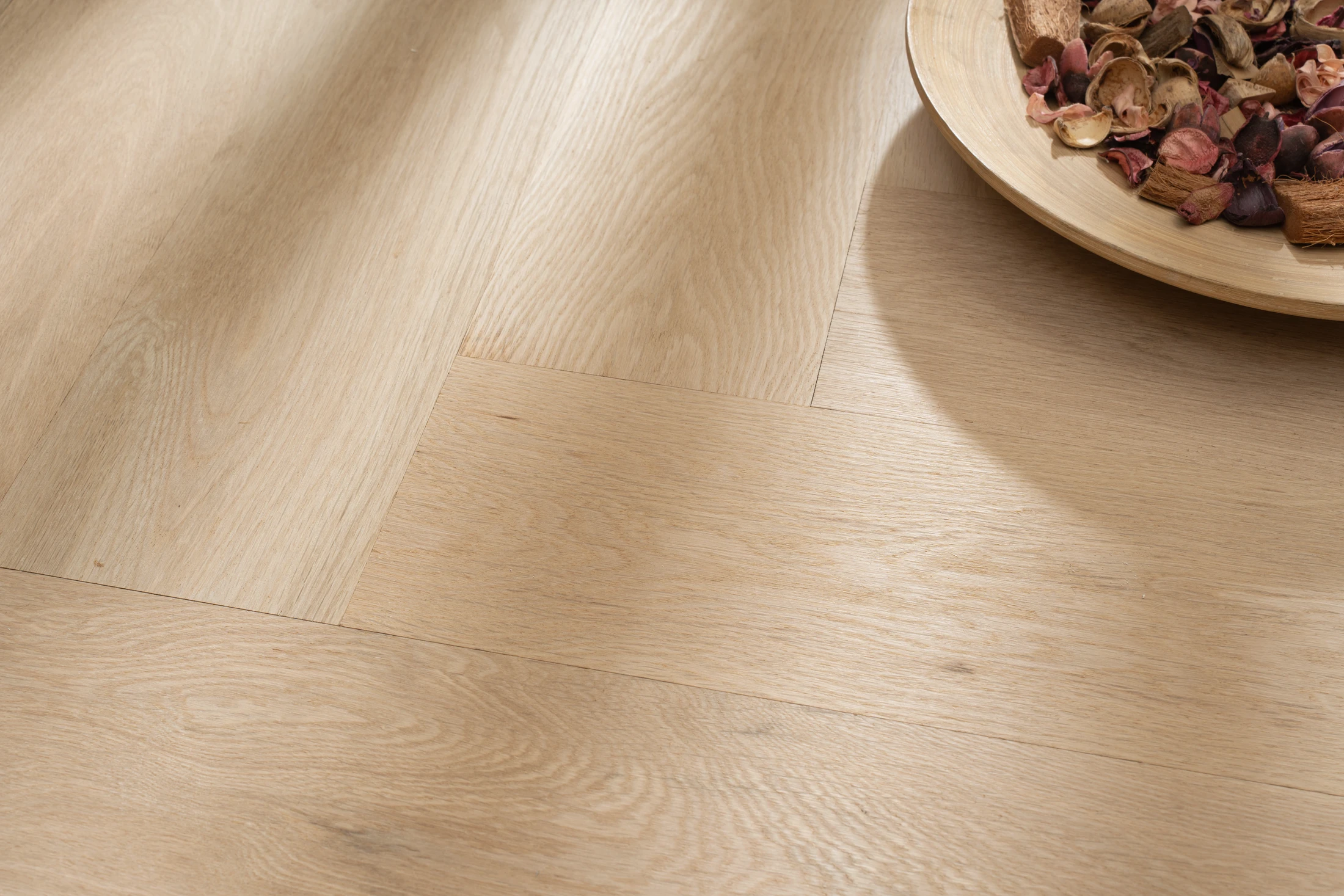
The easiest way to tell them apart is to look at where the boards meet. In herringbone, the end of one rectangular board meets the side of the next. In chevron, two angled ends meet to make a V.
That small difference changes the look of the whole floor. Herringbone has a staggered zigzag; chevron has a clear line running through each row of V shapes. Once you know which look you prefer, compare the actual boards—their size, construction and finish.
At a glance
| Detail | Herringbone | Chevron |
|---|---|---|
| Board shape | Rectangular, with square ends | Cut at an angle at each end |
| Meeting point | End to side | Angled end to angled end |
| The pattern | A staggered, interlocking zigzag | V shapes meeting along a straight line |
| In our range | Engineered oak and raw solid oak | Raw solid oak |
Herringbone: square-ended boards
Herringbone uses rectangular boards laid at right angles to each other. Look closely at a joint: one board finishes against the long side of another. The joints step across the floor rather than lining up down the centre.
Board size makes a noticeable difference here. A small block repeats the pattern more often. A larger board gives you longer stretches of grain between the joints. If you have room to lay out a few samples, it is much easier to judge the scale than from a single board.
Our herringbone range includes engineered oak in five finishes, plus two sizes of raw solid oak.
Chevron: angled board ends
Chevron has matching angled ends that meet to form a V. Those meeting points line up, giving you a clear direction through the floor.
It is worth thinking about that direction when looking at a floor plan. Stand at the main doorway and consider where you want the rows to lead. A hallway and a wide living room may call for different layouts, even with the same boards.
Bestwork’s chevron range is raw solid oak in two sizes. Ask us to confirm the cut angle and board profile for the format you want. The diagram above shows the pattern; it is not a drawing of a particular product.
Both layouts belong to the broader parquetry family. Our oak parquetry guide explains the category and compares the current formats and carton coverage.
The pattern and the board construction
Herringbone and chevron are pattern names. They do not tell you whether the flooring is solid or engineered.
Our engineered herringbone is 15 mm thick, with a 4 mm European oak wear layer. It comes in Burnished Java, Latte Tan, Natural Oak, Satin Greige and Washed Sand. See the 900 × 150 mm engineered herringbone finishes, or compare them with the matching straight-plank range.
Our solid herringbone and chevron boards are 18 mm thick and supplied raw and unstained. The final colour and coating need to be worked out as part of the finishing plan. Discuss that with the person who will install and finish your floor before ordering.
You can check the specifications in our engineered oak collection and solid oak collection.
For raw oak, compare the solid herringbone sizes alongside the solid chevron sizes.
For a closer look at the boards themselves, read our Solid vs Engineered Oak Flooring guide. It covers construction, supplied finishes and questions for your installer.
The sizes in our range
| Format | Construction | Board size | Finish |
|---|---|---|---|
| Engineered herringbone | Engineered oak | 900 × 150 × 15/4 mm | Five matte factory finishes |
| Herringbone 610 | Solid oak | 610 × 125 × 18 mm | Raw / unstained |
| Herringbone 450 | Solid oak | 450 × 90 × 18 mm | Raw / unstained |
| Chevron 590 | Solid oak | 590 × 125 × 18 mm | Raw / unstained |
| Chevron 850 | Solid oak | 850 × 95 × 18 mm | Raw / unstained |
For the engineered board, 15/4 mm means 15 mm overall thickness with a 4 mm oak wear layer. These are the formats shown on our website; confirm the latest specification and availability with us before placing an order.
For dimensions and ordering details, use the 450, 610 and 900 mm herringbone comparison or the 590 vs 850 mm chevron size guide. Check the selected product’s carton coverage when calculating quantities.
Choosing between the two
If you like the way rectangular boards weave into each other, start with herringbone. If you prefer the straight meeting line of repeated V shapes, look at chevron.
Then bring the choice back to the room. Compare the board dimensions with the width of the space, the doorways and the furniture layout. Look at several boards beside your wall and cabinet samples, in daylight and with the lights on.
A room photo is useful for getting ideas. A physical sample is a better reference for colour and grain. Timber varies, so one board will not show every variation you will see in the floor.
Which pattern suits a small room or hallway?
Start with a scaled layout and a few boards placed together. Compare the number of pattern repeats across the room, the direction from the main doorway and the cuts at the edges. A longer board changes the scale of the pattern; it does not automatically make every room look larger. Ask the installer to show how the chosen layout continues through doorways and adjoining spaces.
Assess colour separately from pattern. The light and natural oak finish guide compares three factory-finished options. For raw solid oak, use the unfinished oak guide to plan a physical finish sample with your installer.
Before you order
For retailers, the next step is to get the product and installation details onto the same page. A useful enquiry includes:
- The pattern, construction and board size you want.
- Your project location, approximate area and timing.
- Whether you need samples, a specification sheet or a supply quote.
With your installer, work through the subfloor, fixing method, laying direction and any borders, stairs or transitions. Confirm the board profile and left/right board requirements. For chevron, also confirm the cut angle.
Ask the installer to calculate the allowance for cuts from your layout. We would not apply one waste percentage to every herringbone or chevron project: the room shape and the way the pattern is set out matter.
A few common questions
Is herringbone or chevron flooring cheaper?
The pattern name alone will not give you a useful price comparison. Compare the actual products and ask the installer to quote from the floor plan. For raw solid oak, include the finishing work in that comparison. Use our timber flooring cost and quote checklist to compare supply, delivery, preparation, installation and finishing on the same scope. Obtain project-specific prices for both options before choosing on cost.
Does Bestwork have engineered chevron?
Our current chevron range is solid oak. Engineered herringbone is listed in five finishes at 900 × 150 × 15/4 mm. Tell us which option you are considering so we can check availability.
Can I compare samples before deciding?
Ask about physical samples with the patterns or products you want to compare and your location. We can discuss physical samples, specifications and supply details with you.