
FLOORING GUIDES
European Oak Flooring: Construction, Grades and Finishes
Choosing European oak floorboards starts with construction, grade, supplied finish and board dimensions. Compare Bestwork’s solid and engineered formats.
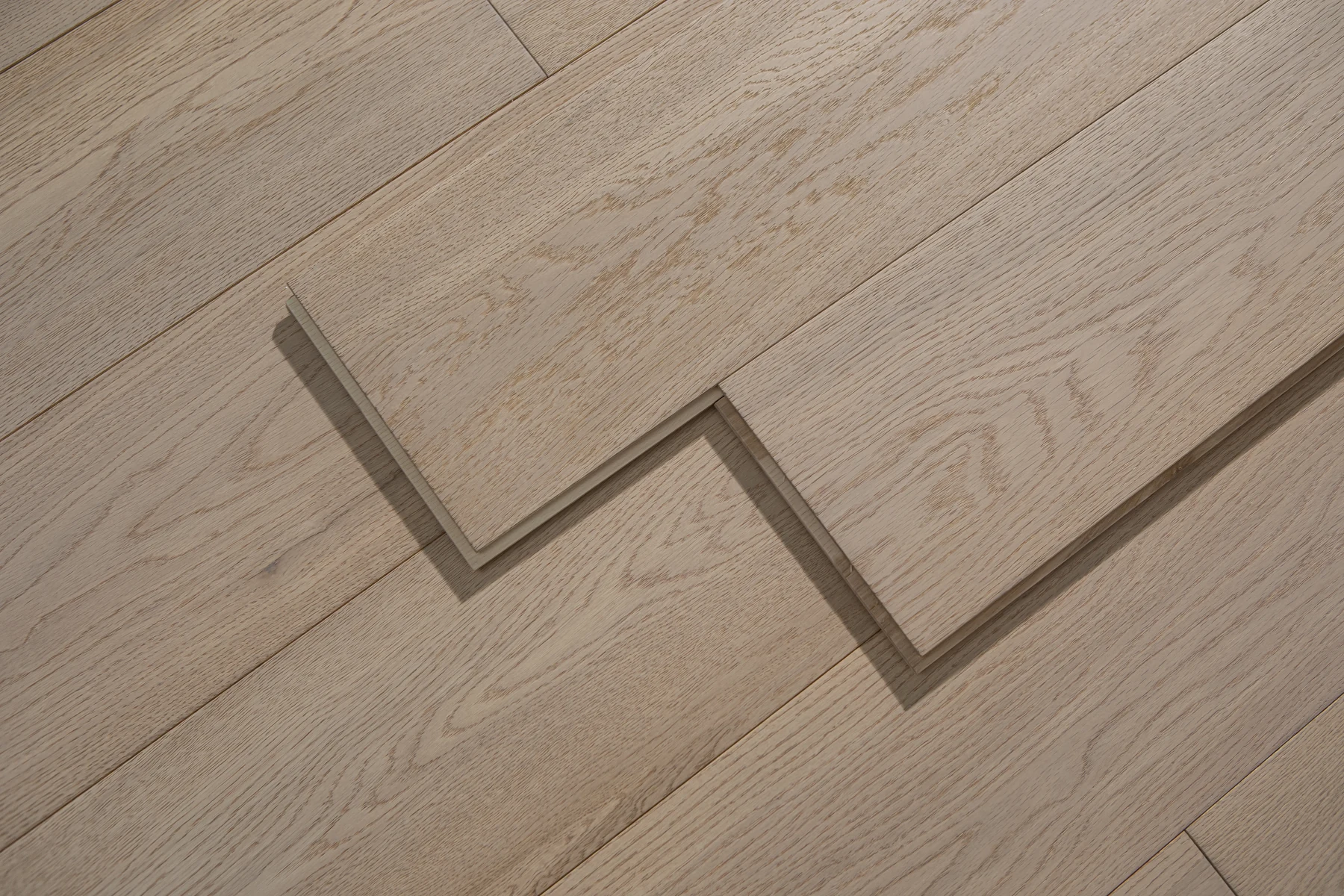
What to check when choosing European oak
European oak flooring describes the timber used in the floor, but it does not tell you everything about the supplied board. Oak floorboards can differ in construction, visible natural features, surface treatment, dimensions and laying pattern. A useful comparison records each of those separately.
At Bestwork, the range includes factory-finished engineered oak in straight plank and herringbone formats, alongside raw solid European oak parquetry. Start with the product specification and a physical sample, then ask your flooring professional to assess the exact product against the project’s site conditions and installation requirements.
Compare solid and engineered construction
An engineered board combines an oak surface with a supporting core. Bestwork’s current engineered range has a 4 mm European oak wear layer over a multi-layer eucalyptus hardwood plywood core, within a total thickness of 15 mm. The solid parquetry range is 18 mm solid European oak, supplied raw and unstained.
| Range | Current board dimensions | Supplied finish | Where to compare |
|---|---|---|---|
| Engineered straight plank | 1900 × 190 × 15/4 mm | Five matte factory finishes | Engineered oak collection |
| Engineered herringbone | 900 × 150 × 15/4 mm | The same five named matte finishes | Herringbone collection |
| Solid herringbone | 610 × 125 × 18 mm or 450 × 90 × 18 mm | Raw / unstained | Solid herringbone |
| Solid chevron | 590 × 125 × 18 mm or 850 × 95 × 18 mm | Raw / unstained | Solid chevron |
Dimensions are length × width × thickness; for engineered boards, 15/4 means total thickness / oak wear layer. Construction and thickness alone do not establish an installation method, suitability for a particular site or a guaranteed number of future sanding cycles. Discuss those questions using the exact product details. The solid versus engineered oak guide provides a fuller comparison.
Understand what an oak grade describes
Grade labels help describe the appearance of natural timber, including the permitted natural features. They should be read with the supplier’s grade description and representative samples. The Australasian Timber Flooring Association’s solid timber specification explains that appearance grading relates to the size and number of features, and that manufacturer grades can differ.
Bestwork’s engineered products are listed as Premium AB Grade; the 610 mm solid herringbone is listed as Selected AB Grade. Do not assume that the letters AB describe an identical appearance across every supplier or product. Ask about colour variation, grain, knots and other visible features for the selected line. A grade name is not, by itself, a structural rating or a promise that every board will look the same.
Decide between a factory finish and raw timber
The engineered collection is offered in Burnished Java, Latte Tan, Natural Oak, Satin Greige and Washed Sand. These are named matte finishes. Select colour beside the surrounding materials and check a physical sample in the project’s light. The light and natural oak colour guide compares the three lighter options.
The solid range is raw and unstained, so the intended appearance must be developed with the selected finishing system. Allow for a separate discussion with the installer or finisher about preparation, compatibility, an approved finish sample and the work programme. Read the unfinished oak flooring guide if site finishing is part of the brief.
Check format, profile and layout together
Straight planks, herringbone and chevron create different lines across a room. Herringbone uses rectangular boards meeting end to side; chevron uses angled ends to form aligned V shapes. The current solid herringbone has a tongue-and-groove profile. The solid chevron is supplied without tongue and groove; confirm its profile and angle with the chosen product before ordering.
Consider the room dimensions, thresholds and adjoining surfaces with your installer. Use the herringbone and chevron comparison for the pattern distinction and the relevant product page for actual dimensions. A room photograph can help you consider proportion, but it should not replace a drawing or product specification.
Put a comparable trade brief together
For a useful supply enquiry, record the construction, pattern, dimensions, grade and finish you are comparing. Add the approximate area, delivery location and intended timing. Ask the installer to confirm the ordering allowance, and check current carton coverage on the product page before finalising quantities.
Bestwork supplies flooring retailers and wholesalers from its own factory, with a supply base in Melbourne’s east. Delivery can be arranged to Victoria, NSW, ACT and Adelaide in South Australia; confirm availability and delivery details for your order. Contact Bestwork about trade supply or use the cost and quote guide to separate flooring supply from installation and site finishing.